Welcome to Copperlink International Company!

- Call Us for help!
- +91 9819742205

Copper Heat Exchanger Coil
Manufacturer,Stockist and Exporter of Copper Heat Exchanger Coil
Copper heat exchanger coils are engineered to transfer heat efficiently across HVAC, refrigeration, and industrial thermal systems. Their molecular structure enables superior thermal conductivity, allowing temperatures to stabilize more quickly. Manufacturers choose copper because it provides balanced heat absorption and controlled dissipation without excessive loss. In HVAC systems, these coils are integrated into evaporators and condensers for reliable climate control. The tubing offers precise flow control, minimizing pressure drops while maintaining temperature stability. Copper’s long-term durability ensures reduced maintenance and fewer performance failures over time. When compared with aluminum or steel, copper provides a higher efficiency output in compact coil designs.
A copper heat exchanger coil typically operates within a continuous cycle of heat exchange. Cool refrigerant enters one side, absorbing ambient heat, and then exits at a higher temperature. The system later compresses this heated refrigerant and expels thermal energy from the coil surface. This energy transfer is both rapid and uniform, assisted by copper’s inherent conductivity. Typical systems use finned or spiral coil shapes to increase active surface area. These design variations directly enhance the coil’s cooling or heating performance. Engineers select coil patterns based on the intended thermal workload and environmental conditions.
The manufacturing process of copper coils begins with high-purity copper tube extraction. Raw copper is refined through smelting and electrolysis to reach optimal conductivity levels. Tube forming techniques such as drawing and extrusion reshape copper into precise diameters. Coils are then bent, wound, and annealed to achieve the required flexibility and strength. End connectors, manifolds, and brazing joints make each coil compatible with complex systems. Special coatings may be applied to improve corrosion resistance in harsh environments. Quality checks include pressure tests, dimensional accuracy, and temperature response verification.
One reason copper coils excel is their excellent corrosion resistance relative to many metals. Copper naturally forms a thin oxide layer that protects against atmospheric damage. In chemically demanding environments, additional anti-corrosion surface treatments are used. This protective approach allows coils to retain their structural integrity for years. Heat exchangers in marine or industrial sectors often rely on these enhanced protections. Copper also resists scaling build-up, reducing thermal blockage and operational inefficiencies. Its endurance contributes to longer replacement intervals and cost-effective system ownership.
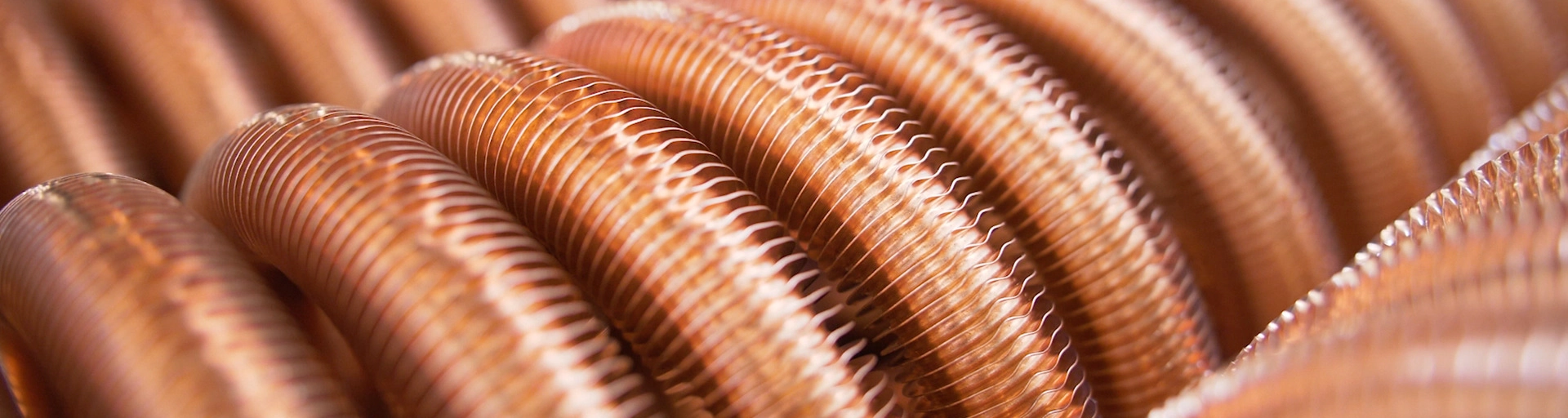
Copper heat exchanger coils are available in many geometries and dimensional ranges. Small coils serve refrigeration cabinets, medical cooling modules, and compact AC units. Medium-scale coils power commercial HVAC systems, office spaces, and retail environments. Large industrial coils support factories, chemical processing, power plants, and energy recovery. Straight, U-bend, serpentine, and spiral tube patterns optimize different performance goals. Each configuration can be customized with variable thickness, fin spacing, and bend radius. This modularity ensures copper coils are adaptable to many engineering specifications.
Thermal efficiency remains the primary advantage of copper coil integration. A well-designed copper exchanger delivers rapid temperature changes with minimal energy waste. Its conductivity allows coils to maintain stable performance under fluctuating loads. Systems that incorporate copper require less power to transfer equivalent heat values. This efficiency reduces compressor wear and lowers electrical consumption over the coil’s lifecycle. Even in extreme climates, copper coils retain consistent functional output. Their thermal reliability is crucial for mission-critical temperature-controlled environments.
Copper also performs exceptionally in brazing and welding processes. Its compatibility with silver, phosphorus, and copper-based brazing alloys makes assembly efficient. These joints produce leak-resistant seals capable of sustaining variable pressure cycles. Heat exchanger coils often undergo repeated stress from expansion and contraction. Brazed copper connections withstand these movements without fracturing. As a result, manufacturers can design compact coils with reliable joins and minimal leaks. This feature is essential in refrigeration systems where gas containment is mandatory.
Efficiency is further enhanced by finned coils, which increase surface contact with air or fluid. Copper fins or aluminum fins bonded to copper tubes accelerate energy transfer rates. The increased surface area helps dissipate or absorb heat faster than smooth tubes alone. This innovation is widely applied in air conditioners, industrial dryers, and process coolers. Fin spacing and thickness alter air velocity, pressure resistance, and overall performance. Design engineers frequently simulate airflow to determine optimal fin arrangements. These simulations reduce prototype costs and accelerate mass production readiness.
Specification Of Copper Heat Exchanger Coil
| Specification | Details |
|---|---|
| Material Grade | Cu-ETP (C11000) / Cu-DHP (C12200) / High Conductivity Copper |
| Tubing Outer Diameter (OD) | 4 mm – 18 mm (Custom sizes available) |
| Wall Thickness | 0.30 mm – 2.00 mm |
| Coil Configuration | Serpentine / U-Bend / Spiral / Microchannel |
| Fin Type | Louvered / Plain / Offset / Micro-fin |
| Fin Material | Aluminum / Copper / Composite |
| Fin Pitch (FPI) | 8 – 22 Fins Per Inch |
| Working Pressure | Up to 60 bar (Design dependent) |
| Temperature Range | -196°C to 300°C |
| Connection Method | Brazed / Welded / Flanged / Compression |
| Surface Coating | Epoxy / Hydrophobic / Anti-Corrosion / Nano-Coat |
| Thermal Conductivity | 385–401 W/m·K (based on copper grade) |
| Typical Applications | HVAC, Refrigeration, Condensers, Evaporators, Heat Recovery Units, Industrial Cooling |
| Customization | Custom coil geometry, bending radius, tube thickness, fin design, and manifold options |
Maintenance requirements for copper coils are generally low compared with other metals. Cleaning involves gentle brushing, chemical rinse, or mild pressure washing to remove debris. Copper resists oxidation buildup, decreasing frequency of service intervals. When damage occurs, coils can be repaired rather than fully replaced. Patch brazing restores structural integrity without affecting surrounding tubes. End users benefit from minimal downtime and reduced operational expenditure. The long-term maintenance profile makes copper a preferred investment for system designers.
In refrigeration applications, copper coils form a critical part of evaporator loops. They absorb heat from cooled compartments, allowing refrigerants to vaporize efficiently. The vapor moves toward compressors where temperature and pressure rise. After condensing, the refrigerant returns to another copper coil section to release heat. This circulating behavior underpins reliable refrigeration in domestic or commercial units. Superior conductivity ensures consistent temperature uniformity inside storage compartments. All processes rely on precise copper coil engineering to maintain system balance.
Industrial systems often require high-pressure and high-temperature performance. Copper coils handle these challenges due to their robust tensile and fatigue properties. Power generation facilities use copper exchangers for turbine cooling and steam condensation. Chemical plants rely on copper tubing to regulate reaction vessel temperatures. Heat recovery units in manufacturing capture excess thermal waste using copper matrices. Such installations must operate continuously, sometimes in corrosive atmospheres. Copper withstands these harsh conditions while retaining thermodynamic stability.
Chemical Properties Of Copper Heat Exchanger Coil
| Element | Symbol | Typical Composition (%) | Description / Role |
|---|---|---|---|
| Copper | Cu | 99.90 – 99.99 | Primary element providing high thermal conductivity and corrosion resistance. |
| Phosphorus | P | 0.015 – 0.040 (Cu-DHP) | Deoxidizing agent; improves weldability and enhances corrosion resistance. |
| Silver | Ag | 0.002 – 0.010 | Improves high-temperature stability and electrical/thermal conductivity. |
| Oxygen | O | 0.02 – 0.04 (Cu-ETP) | Residual oxygen present in electrolytic tough pitch copper; enhances electrical conductivity. |
| Lead | Pb | ≤ 0.005 | Unavoidable trace impurity; excessive levels decrease mechanical integrity. |
| Iron | Fe | ≤ 0.005 | Minor impurity; minimal effect on copper properties when within tolerance. |
| Arsenic | As | ≤ 0.005 | Trace element; controlled to prevent ductility loss. |
| Total Other Elements | — | ≤ 0.03 | Combined impurities maintained below specification to ensure product performance. |
Energy efficiency initiatives worldwide are increasing copper coil demand. Government standards for HVAC performance encourage high-conductivity materials. Copper enables compliance without complex modifications or oversized components. It supports greener operation by reducing carbon emissions tied to energy consumption. Manufacturers also recycle copper coils easily, decreasing environmental waste. Recycling helps lower material cost for new coil production and improves sustainability. This lifecycle advantage strengthens copper’s role in future-ready technologies.
Customization is a key aspect of copper coil production. Engineers specify length, diameter, bend angle, and manifold positioning. Some designs integrate micro-channels or multi-tube assemblies for enhanced fluid flow. These custom solutions support unique industrial or climate control challenges. Thicker walls increase pressure tolerance, while thinner tubes boost heat exchange rate. By selecting appropriate parameters, each coil fits its intended performance environment. Manufacturers often collaborate with clients to tailor coil prototypes to system constraints.
Applications & Uses of Copper Heat Exchanger Coil
| Industry / Sector | Application | Purpose / Function |
|---|---|---|
| HVAC (Heating, Ventilation & Air Conditioning) | Air conditioners, split AC, VRF/VRV units | Efficient cooling and heat transfer in evaporators and condensers. |
| Refrigeration | Commercial freezers, cold rooms, display coolers | Absorbing and releasing heat for stable refrigerated environments. |
| Industrial Processing | Heat recovery systems, dryers, process coolers | Managing process temperatures and maximizing energy efficiency. |
| Power Generation | Steam condensers, turbine cooling systems | Condensing steam and dissipating heat from high-energy equipment. |
| Chemical & Petrochemical | Fluid heat exchangers, reactor temperature control | Maintaining stable heat transfer in harsh and corrosive conditions. |
| Electronics & Semiconductor | Server cooling, component cooling modules | Rapid heat dissipation to protect sensitive electronic systems. |
| Automotive | Radiators, intercoolers, HVAC coils | Cooling internal combustion engines and in-cabin climate systems. |
| Renewable Energy | Geothermal heat pumps, solar thermal systems | Transferring absorbed solar or ground heat to functional systems. |
| Medical & Healthcare | Lab chillers, MRI cooling systems | Maintaining precise low-temperature environments for sensitive equipment. |